Breast Lift + Augmentation
Combines a lift and implants in one surgery — for breasts that have both sagged and lost volume, providing restoration neither procedure alone can achieve.
What it treats
After significant weight loss or completing pregnancy and breastfeeding, breasts can both deflate and sag — losing volume while the nipples point downward and excess skin remains. Chest exercises cannot fix either change, since breasts are glandular tissue, fat, and skin, not muscle. These are normal biological outcomes, not personal failures. When both volume loss and sagging are present, combining a breast lift with augmentation in one surgery provides comprehensive restoration that neither procedure alone can achieve.
Hospital-based care
Every combined procedure is performed at Winchester District Memorial Hospital — not a private surgical suite — with an anesthetist and full ability to admit if ever needed.
Why combine, rather than stage separately
Combining a lift and augmentation in one surgery provides comprehensive restoration — both position and volume — with a single anesthesia exposure and recovery period, a coordinated aesthetic outcome, and lower total cost than staging the two separately. The trade-off: combined surgery is more extensive, with longer operative time and recovery than either procedure alone.
Day of surgery
- Incision placement — according to the planned lift technique (periareolar, vertical, or anchor).
- Breast pocket creation — a pocket is created for implant placement (submuscular, subglandular, or dual-plane).
- Excess skin removal — stretched, loose breast skin is surgically removed.
- Implant insertion — implants are inserted and positioned precisely.
- Tissue reshaping — remaining breast tissue is lifted, reshaped, and tightened.
- Nipple repositioning — the nipple-areola complex is repositioned to an optimal height.
- Incision closure — closed in layers with dissolvable sutures.
- Support garment — a surgical support bra applied to support healing.
Recovery timeline
Moderate to significant discomfort. Swelling and bruising normal. Breasts temporarily positioned high. Support bra worn continuously. Limited arm movement.
Discomfort decreases significantly. Return to light activities and desk work. Breasts begin “dropping” into a more natural position.
Most swelling resolved. Implants settling into final position. Gradual return to exercise. Scars softening.
Swelling completely resolved and implants fully settled by 3–6 months; final results fully apparent by 6–12 months.
Recovery timelines vary by individual healing. These ranges are general guidance — your actual timeline will be discussed during consultation.
Scar expectations
Incision pattern depends on the degree of sagging — periareolar for mild sagging, vertical (most common for combined procedures) for moderate sagging, or anchor for severe sagging with substantial excess skin. Initial scars appear red and prominent for 2–3 months, fading to thin, flat lines over 6–12 months. Scars never disappear completely but typically become much less noticeable, strategically placed to be concealed by clothing and most swimwear.
Am I a candidate?
Good candidates typically:
- Have breasts that have both sagged and lost volume, with nipples pointing downward or below the crease
- Desire both elevated position and enhanced fullness
- Have maintained a stable weight for 6–12 months
- Are a non-smoker, or willing to stop 4–6 weeks before and after surgery
- Are prepared for a more extensive recovery than either procedure alone
Cost & financing
Typical range: $14,000–$18,000 CAD — more than a single procedure, but typically less than performing both separately over time (two separate surgeon fees, anesthesia fees, and recovery periods). Your quote includes the surgeon’s fee, implants, hospital operating room fees, anesthesia, support garments, and a year of follow-up care. Not covered by OHIP or private insurance; financing options are available.
Results
Every patient’s anatomy, goals, and healing are different — these photos are intended to help you understand what this procedure can achieve, not to predict your own outcome.
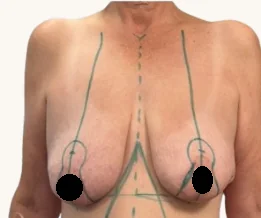
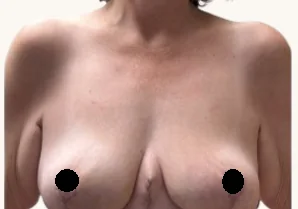

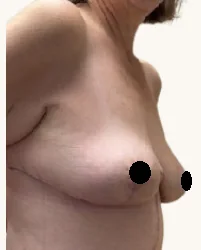
Results are not guaranteed. Individual results may vary.
Risks & safety
As with any surgery, combining a lift with augmentation carries real risks worth understanding upfront — since it combines two procedures, some risks are more relevant given the longer combined surgery:
- Bleeding or fluid buildup (seroma/hematoma)
- Infection
- Delayed wound healing
- Changes in nipple or skin sensation
- Capsular contracture
- Implant malposition, rupture, or leak
- A rare risk of BIA-ALCL (a lymphoma associated with certain implant surfaces)
- Impact on future ability to breastfeed
- Blood clots (DVT/PE) — a more relevant risk given the longer combined surgery time
- Asymmetry or unfavorable scarring
- Contour irregularities or deformities
- Need for reoperation or revision surgery
- Dissatisfaction with cosmetic outcome
- Anesthesia-related risks, including rare risk of death
Dr. Borsuk will walk through how these risks apply specifically to your case, and what’s done to minimize them, before you consent to surgery.
Frequently asked questions
Why combine both procedures instead of doing them separately?
Combining provides comprehensive restoration (position and volume together), a single anesthesia exposure and recovery, and a more cost-effective path than staging — though it’s more extensive surgery with a longer recovery than either alone.
Can I breastfeed after combined breast surgery?
Combined procedures may affect breastfeeding ability more than a single procedure, due to more extensive tissue manipulation. Many women still breastfeed successfully — discuss this during consultation if it matters to you.
How long do results last?
The lift component typically lasts 10–15+ years; implants may last 10–20+ years but aren’t lifetime devices. Natural aging and gravity continue to affect results over time.
What size implant should I choose with a lift?
Dr. Borsuk will guide you toward a size that supports healthy blood supply to healing tissue, reduces complication risk, and creates natural, proportionate results — conservative sizing is often best with combined procedures.
Is combined breast surgery right for you?
The clearest way to know is a private consultation — we’ll assess your anatomy and whether combining or staging fits your goals.
Schedule a Consultation