Thigh Lift (Thighplasty)
Removes excess inner thigh skin that causes chafing and discomfort — skin that persists no matter how strong the muscle underneath becomes.
What it treats
After significant weight loss — whether through lifestyle change, bariatric surgery, or GLP-1 medications — loose, sagging inner thigh skin can remain, even with strong muscle built underneath. This tissue is a normal biological outcome of significant weight loss: when skin is stretched beyond its capacity for years, it loses the ability to retract naturally, causing chafing during walking, interfering with activity, and making clothing uncomfortable. A thigh lift surgically removes this excess skin — and, if needed, stubborn fat — for smoother, more proportionate legs.
Hospital-based care
Every thigh lift is performed at Winchester District Memorial Hospital, with an anesthetist, full emergency capabilities, and DVT prevention protocols given the extended time on the operating table.
What a thigh lift is not
- A weight-loss procedure — you should be at a stable, healthy weight first
- A substitute for exercise or leg workouts
- A cellulite treatment, though some surface irregularities may improve incidentally
Approach
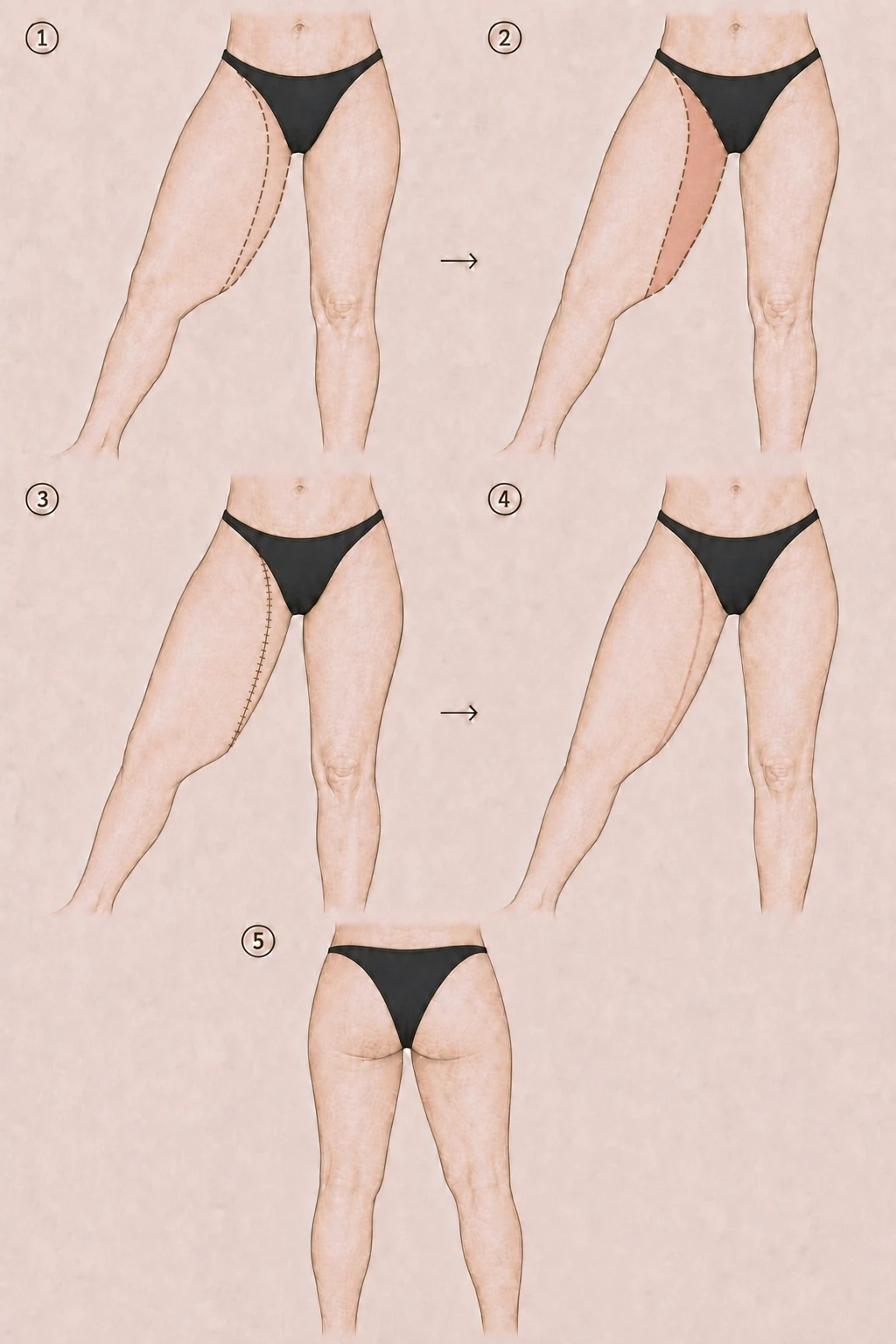
Dr. Borsuk’s thigh lift addresses inner thigh skin. For mild excess, the incision sits along the groin crease only. For more extensive sagging after massive weight loss, a vertical incision extends down the inner thigh toward the knee in addition to the groin crease scar — worth knowing upfront, since the vertical portion can be visible not just in swimwear, but also with shorts or skirts.
Day of surgery
- Incision placement — along the groin crease, extended down the inner thigh if a vertical lift is needed.
- Tissue removal — excess skin is removed; stubborn fat may be addressed with liposuction at the same time.
- Skin tightening — remaining skin is redraped and tightened over the underlying muscle and tissue.
- Incision closure — closed in layers with dissolvable sutures, with particular attention to durability of the groin closure given the area’s movement.
- Compression garment — applied after the first couple of weeks to support healing and reduce swelling.
Recovery timeline
Moderate to significant discomfort. Walking is difficult and mobility very limited — bed rest with legs elevated is typical.
Pain decreasing, swelling improving. Walking becomes more comfortable. Drains typically removed by week 2. Return to desk work.
Continued swelling reduction. Light exercise (walking, upper body work) — still no lower-body strength training or high-impact activity.
Full release to exercise, including lower-body strength training and running, without restriction.
Swelling fully resolves and final thigh contour becomes visible; scars continue maturing and fading.
Recovery timelines vary by individual healing and the extent of the procedure. These ranges are general guidance — your actual timeline will be discussed during consultation.
Scar expectations
Groin-crease scars are generally well-hidden in the body’s natural crease. When a vertical incision is needed, it extends down the inner thigh toward the knee and is visible not only in swimwear, but also with shorts or skirts — worth being fully comfortable with beforehand. Both types of scar appear red and raised for 2–3 months, then gradually fade to thin, flat lines over 6–12 months — final appearance varies by genetics and scar care.
Am I a candidate?
Good candidates typically:
- Have excess, sagging inner thigh skin that persists despite leg exercise
- Experience chafing or discomfort during walking
- Have maintained a stable weight for 6–12 months, whatever the path there
- Are a non-smoker, or willing to stop 4–6 weeks before and after surgery
Important: a thigh lift requires incisions in the groin area, with scars that fade but never disappear completely — worth being fully comfortable with beforehand.
Cost & financing
Typical range: $14,000–$19,000 CAD, depending on the type of lift (inner, bilateral, or vertical), extent of excess skin, and whether combined with liposuction. Your quote includes the surgeon’s fee, hospital operating room fees, anesthesia, a compression garment, and a year of follow-up care. Not covered by OHIP or private insurance; financing options are available.
Results
Every patient’s anatomy, goals, and healing are different — these photos are intended to help you understand what this procedure can achieve, not to predict your own outcome.

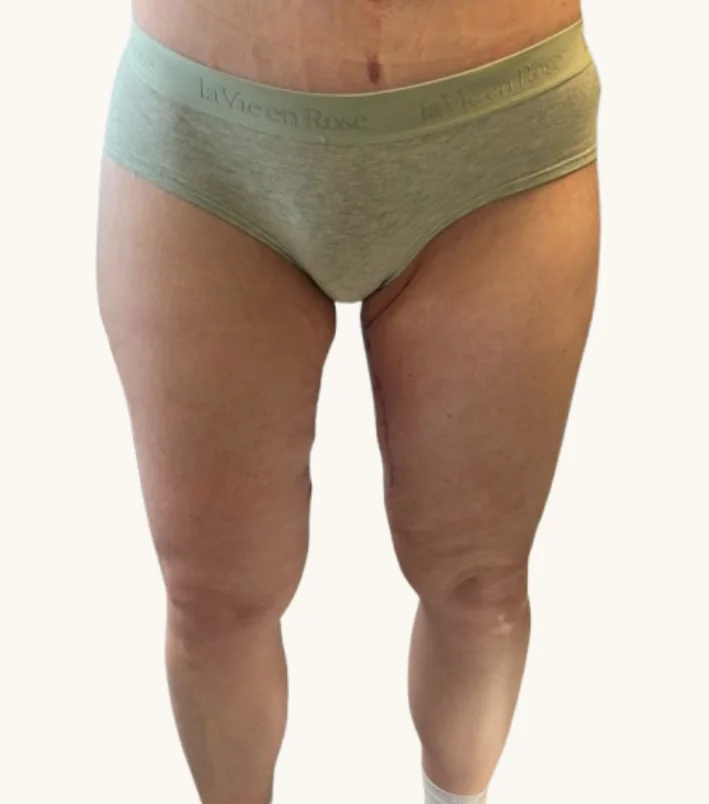
Results are not guaranteed. Individual results may vary.
Thigh lift vs. liposuction
A thigh lift addresses excess, sagging skin — the right choice when skin has lost elasticity after weight loss. Liposuction addresses stubborn fat only and does not tighten skin; if significant excess skin is present, liposuction alone can make its appearance worse. Many patients benefit from combining both for a more complete result.
Combining with other procedures
A thigh lift pairs well with a tummy tuck for patients with excess skin in both areas, addressing upper and lower body in one recovery period. It can also be combined with an arm lift, or included as part of a full body lift for patients with excess skin across multiple areas.
Risks & safety
As with any surgery, a thigh lift carries real risks worth understanding upfront rather than glossing over:
- Bleeding or fluid buildup (seroma)
- Infection
- Delayed wound healing, particularly at the groin
- Changes in skin sensation
- Lymphedema of the leg — a real risk given the groin’s lymphatic tissue
- Blood clots (DVT/PE) — a more relevant risk given the leg involvement
- Asymmetry or unfavorable scarring
- Contour irregularities or deformities
- Need for reoperation or revision surgery
- Dissatisfaction with cosmetic outcome
- Anesthesia-related risks, including rare risk of death
Dr. Borsuk will walk through how these risks apply specifically to your case, and what’s done to minimize them, before you consent to surgery.
Frequently asked questions
How visible are thigh lift scars?
Groin-crease scars are hidden in a natural body crease. When a vertical incision is needed, it extends toward the knee and is visible not just in swimwear, but also with shorts or skirts. Most patients feel the functional benefits — no more chafing, improved mobility — outweigh the visible scarring, which fades significantly over 12–18 months.
Will a thigh lift stop chafing completely?
For most patients, yes — removing the excess skin that causes thigh-to-thigh rubbing eliminates or dramatically reduces chafing, though minor friction may still occur.
When can I exercise again?
Gentle walking is encouraged right away. Upper-body exercise at 2–3 weeks, lower-body at 4–6 weeks minimum, running or high-impact activity at 6–8 weeks, and heavy squats or lunges at 8–12 weeks.
Can I have a thigh lift if I want to lose more weight?
It’s best to wait until your weight has been stable for 6–12 months — operating before stabilization can lead to additional loose skin developing afterward and compromised results.
Is a thigh lift right for you?
The clearest way to know is a private consultation — we’ll talk through your anatomy and goals honestly.
Schedule a Consultation