Bra Line Back Lift
Removes excess skin from the upper and mid-back — the rolls and bra-line bulges that persist no matter how strong the back muscle underneath becomes.
What it treats
After significant weight loss, loose, rolling skin across the back can remain — creating bulges at the bra line, folds along the mid-back, and discomfort with certain clothing, even after building back muscle through exercise. This is a normal biological outcome of significant weight loss: when back skin is stretched significantly for years, it loses the ability to retract naturally. A back lift surgically removes this excess skin, creating a smoother, firmer silhouette that reflects the work already done.
Hospital-based care
Every back lift is performed at Winchester District Memorial Hospital, with an anesthetist and full emergency capability on-site.
What a back lift is not
- A weight-loss procedure — you should be at a stable weight first
- A substitute for back exercises or strength training
- A treatment for poor posture, though improved confidence may change how you carry yourself
Day of surgery
- Incision placement — a horizontal incision across the upper or mid-back, typically along the bra line.
- Tissue removal — excess back skin is removed; stubborn fat may be addressed with liposuction at the same time.
- Skin tightening — remaining skin is pulled upward and tightened for a smoother back contour.
- Incision closure — closed in multiple layers with dissolvable sutures; drains may be placed to prevent fluid accumulation.
- Compression garment — applied to minimize swelling and support healing.
Recovery timeline
Moderate discomfort. Avoid lying flat on your back initially. Drains typically removed after 7–10 days. Limited upper-body movement.
Discomfort decreases significantly. Return to light activities and desk work, and gradually back to normal sleeping positions.
Most swelling resolved. Gradual return to upper-body and aerobic exercise. Scars begin to flatten.
Scars begin fading and full range of motion is restored as swelling fully resolves.
Final results apparent; scars continue lightening over 12–18 months.
Recovery timelines vary by individual healing and the extent of the procedure. These ranges are general guidance — your actual timeline will be discussed during consultation.
Scar expectations
The horizontal incision is positioned along the bra line, hidden beneath bra straps and most clothing, though visible in backless tops, strapless dresses, or swimwear. Scars are red and raised for 2–3 months, then fade to thin white or pink lines over 6–12 months. Silicone scar sheets (starting around 4–6 weeks), sun protection for at least a year, and scar massage once fully healed all support the best long-term appearance.
Am I a candidate?
Good candidates typically:
- Have excess, sagging skin on the upper or mid-back, or bra-line bulging
- Have maintained a stable weight for 6–12 months, whatever the path there — lifestyle change, GLP-1 medication, or bariatric surgery
- Are a non-smoker, or willing to stop 4–6 weeks before and after surgery
- Are comfortable with a horizontal scar across the back along the bra line
Cost & financing
Typical range: $8,000–$17,000 CAD. Your quote includes the surgeon’s fee, hospital operating room fees, anesthesia, a compression garment, and a year of follow-up care. Not covered by OHIP or private insurance; financing options are available.
Results
Every patient’s anatomy, goals, and healing are different — these photos are intended to help you understand what this procedure can achieve, not to predict your own outcome.

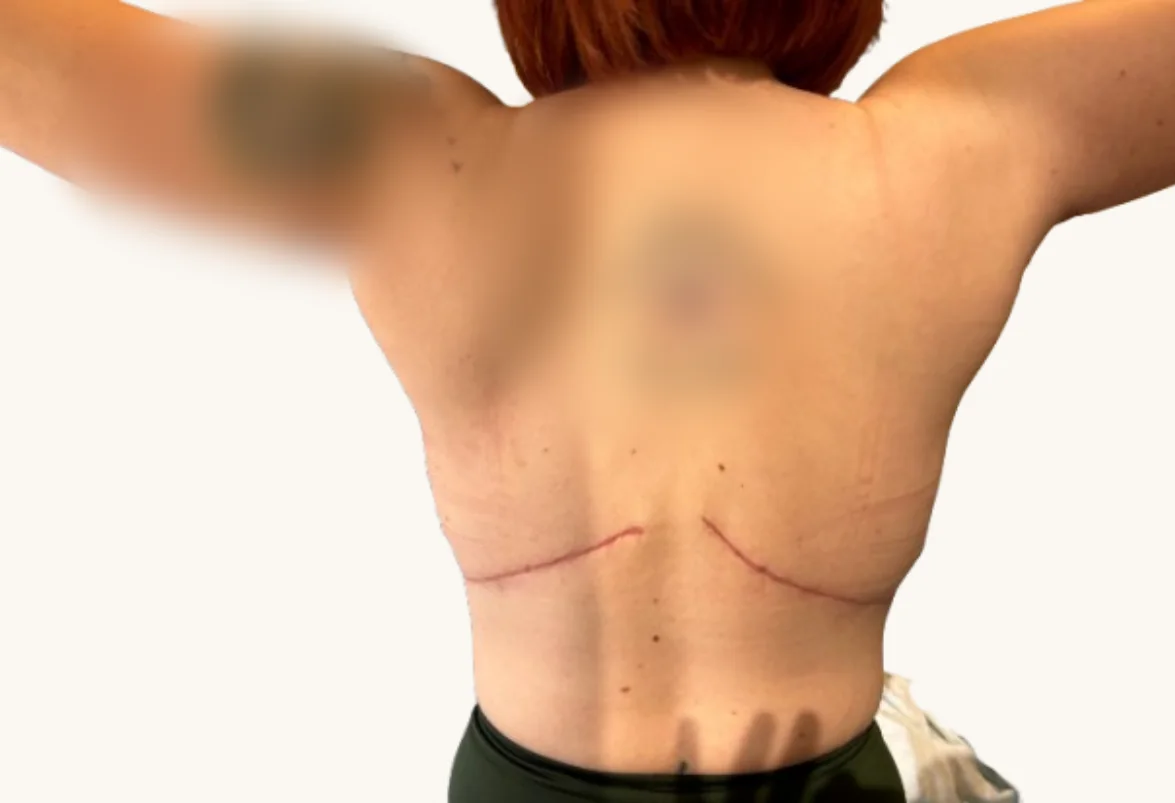
Results are not guaranteed. Individual results may vary.
Combining with other procedures
Back lift is most commonly combined with a tummy tuck or body lift, since patients with excess back skin often have excess abdominal skin too — combining reduces overall recovery time and cost, though back lift can also be performed alone. It’s also commonly paired with breast surgery (lift, reduction, or augmentation) as part of a comprehensive upper-body transformation.
Risks & safety
As with any surgery, a back lift carries real risks worth understanding upfront rather than glossing over:
- Bleeding or fluid buildup (seroma)
- Infection
- Delayed wound healing
- Changes in skin sensation
- Blood clots (DVT/PE)
- Asymmetry or unfavorable scarring
- Contour irregularities or deformities
- Need for reoperation or revision surgery
- Dissatisfaction with cosmetic outcome
- Anesthesia-related risks, including rare risk of death
Dr. Borsuk will walk through how these risks apply specifically to your case, and what’s done to minimize them, before you consent to surgery.
Frequently asked questions
Is a back lift usually done alone or with other procedures?
Most commonly combined with a tummy tuck or body lift, since excess back skin and excess abdominal skin often occur together — but it can be performed alone if that’s all that’s needed.
How should I sleep after a back lift?
Avoid lying flat on your back for the first 1–2 weeks. Sleep on your side or stomach if comfortable, gradually returning to your back as healing allows.
When can I wear a bra again?
You’ll wear a surgical compression garment initially, typically transitioning to a soft, underwire-free bra after 2–3 weeks, per Dr. Borsuk’s guidance.
Can I combine a back lift with breast surgery?
Yes — this creates a comprehensive upper-body transformation and is common when back lift is part of a broader mommy makeover.
Is a back lift right for you?
The clearest way to know is a private consultation — we’ll talk through your anatomy and whether combining procedures makes sense.
Schedule a Consultation